Ideological Sniping
I’m heading back into work tomorrow after a week off. The first half of the week was glorious, but the back half, and especially today, has incurred that particular sort of creeping dread … you know the feeling.
Naturally, I wanted to explore these feelings, and my instinct was to pen one of those bitter class deconstructions I love so much. I’ve plenty to say, but nothing that hasn’t been said umpteen times by those more erudite than I.
More than that though, in my quest to conceptualize others in my life as connected parts of a grander unity I call self, I’m going to try and avoid doing anything that casts blame or aspersions externally, and instead redirect that motivation to perform a deconstruction around a particular flaw of mine (in the classical, individualistic sense) that tends to manifest at work. Perhaps in this way I can minutely reduce how much of this same dread I put out into the world.
So, you ever noticed this?
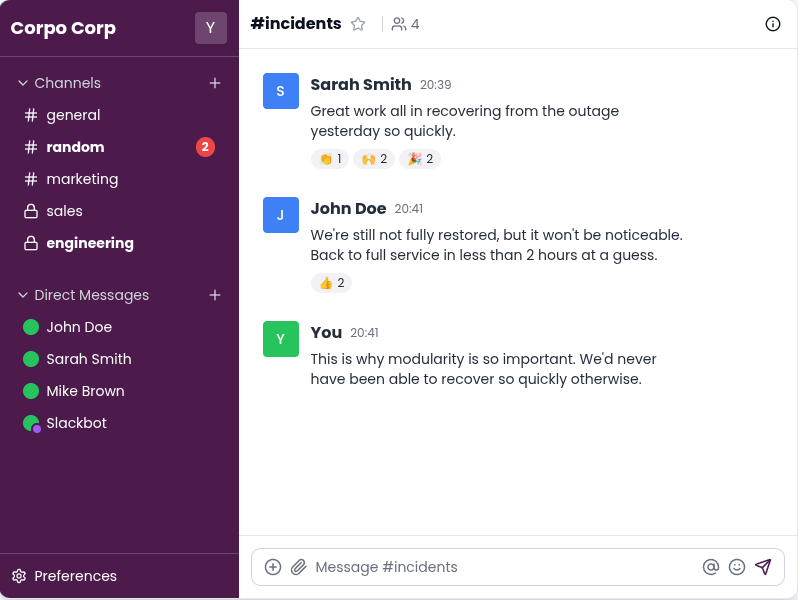
Oh look at that, there I go, making an ideological point out of a regular day to day occurrence. This seemingly harmless pattern is something I am going to call Ideological Sniping, and I do it all the damn time.
You’ll note that this isn’t even a controversial take, in this contrived example, modularity is important. However, the fact that I feel the need to make that point is, in my opinion, ugly. It’s paternalistic, as though others can’t make that connection and need me to do it for them.
The worst effect of this sort of sniping is the reduction in trust. More often than not, even if I feel that the discussion in question and the ideological point are actually related, I’m normally massaging reality at least somewhat to fit it into a specific point. In the moment, I don’t consider others complexly enough to imagine them noticing, but they do. They are more than names on a screen, they are full, complete people who understand that reality is more complicated than glib one-liners. I notice it when it’s done to me, so there’s no reason to assume others won’t.
Heck, folks probably won’t even say anything about it, who wants to get into an argument over something so petty? I may even get enthusiastic agreement, but I suspect trust is eroded all the same.
More practically, I don’t think that this is an effective way to win allies. I’ve long believed that you can’t really convince anyone on any specific point, due to the connected, connotative nature of knowledge and intuition. It’s obvious to anyone who is looking that people (and I know this, because I am people, and people are me) only become truly effective as collaborators when they come to believe in any given endeavour via their own means and own reasoning. Through this, we will find ourselves with collaborators able to generate consistent theories of their own accord, with sincerely held ideological belief serving as deeper anchors into ground truth, rather than the surface level pattern-matching you have to do when you’re faking it.
There are better ways to get at this. A culture of continual improvement and retrospection, celebrating shifts in opinion rather than condemning them, but I think mostly through unalloyed praise and admiration.
This praise should be given regardless of whether it supports our personal ideologies or not. If we’re right, then we’ll find that correctness naturally expressed more frequently, with the people around us picking up on it and making the connections themselves. If we’re wrong, and we’re acting in good faith, then we probably won’t even notice our opinions slowly and painlessly shifting to match reality. More often than not we’ll continue to believe that we’ve been on the money the whole time.
The best outcome of this however has little to do with effectiveness, and much more to do with projecting a positive balance of esteem and delight into the world, even in little ways.
This sniping, whilst minor in the grand scheme, is something I need to be on top of more than ever these days. I’ve held influence for long enough that I have an effect on others, and I can’t necessarily rely on anybody else to check me on this, for the exact same reason I don’t tend to check my superiors when I am subject to the stray sniper round. Who’s got time for the argument eh?